

1 in 25,000... The Orchid That Broke the Rules
Out of 25,000 species of orchid on Earth, only one of them produces something that you can actually eat.
Orchids are the largest, or second largest, family of flowering plants on the planet, with about 25,000 known species. They come in every shape evolution has ever experimented with. Flowers that mimic bees so convincingly that male bees try to mate with them. Flowers shaped like human faces. Flowers that smell like rotting meat to attract flies. Twenty-five thousand variations on the same basic idea, refined over 112 million years of adaptation.
And only one of them, Vanilla planifolia, figured out how to produce something a human being would want to eat.
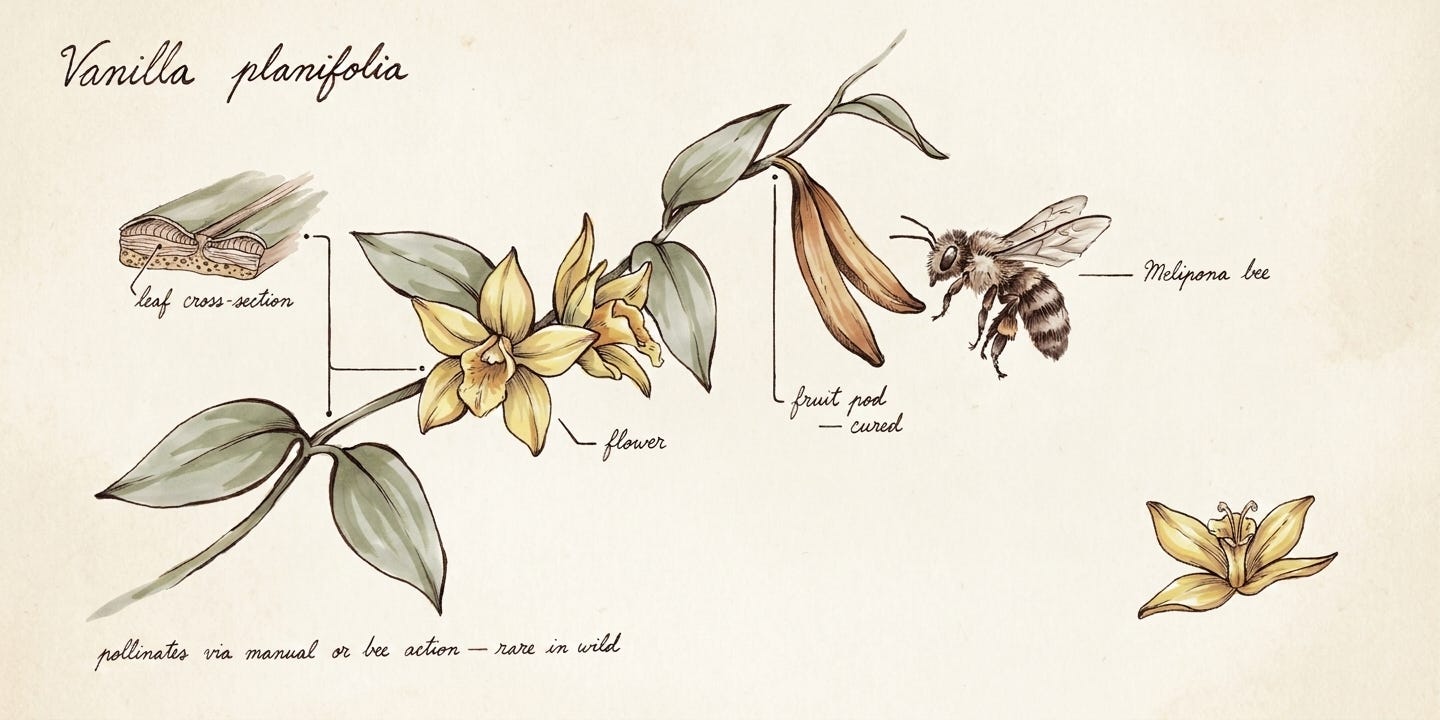
The plant that did it doesn’t even really look like an orchid. Vanilla is a climbing vine, not a potted flower so it starts its life rooted in soil, and as it grows it sends out aerial roots that grab onto a host tree and pull the entire plant upward. If you were to forget about it, the vine would stretch up to 30 meters long, nearly 100 feet, wrapped around a tree trunk like it’s climbing a ladder no one else can see.
It does this because it has almost no other way to survive. Living without roots in the soil for most of its length, the plant has had to improvise. The stems and leaves swell with stored water and a waxy coating keeps the tropical rain from rotting it. It even opens its pores only at night to avoid losing moisture in the heat. Every part of the plant is solving the same problem in a different way… how do you live your whole life hanging in the air.
Then… it flowers. And the flower is where things get strange. Each blossom is pale green-yellow, only a few inches across. It opens for no longer than 24 hours and if it isn’t pollinated in that window, it dies, having produced nothing.
One day… That’s the entire negotiation window between this plant and the rest of the world.
Keep reading with a 7-day free trial
Subscribe to The Insane Archive to keep reading this post and get 7 days of free access to the full post archives.