

Carrots Weren't Always Orange
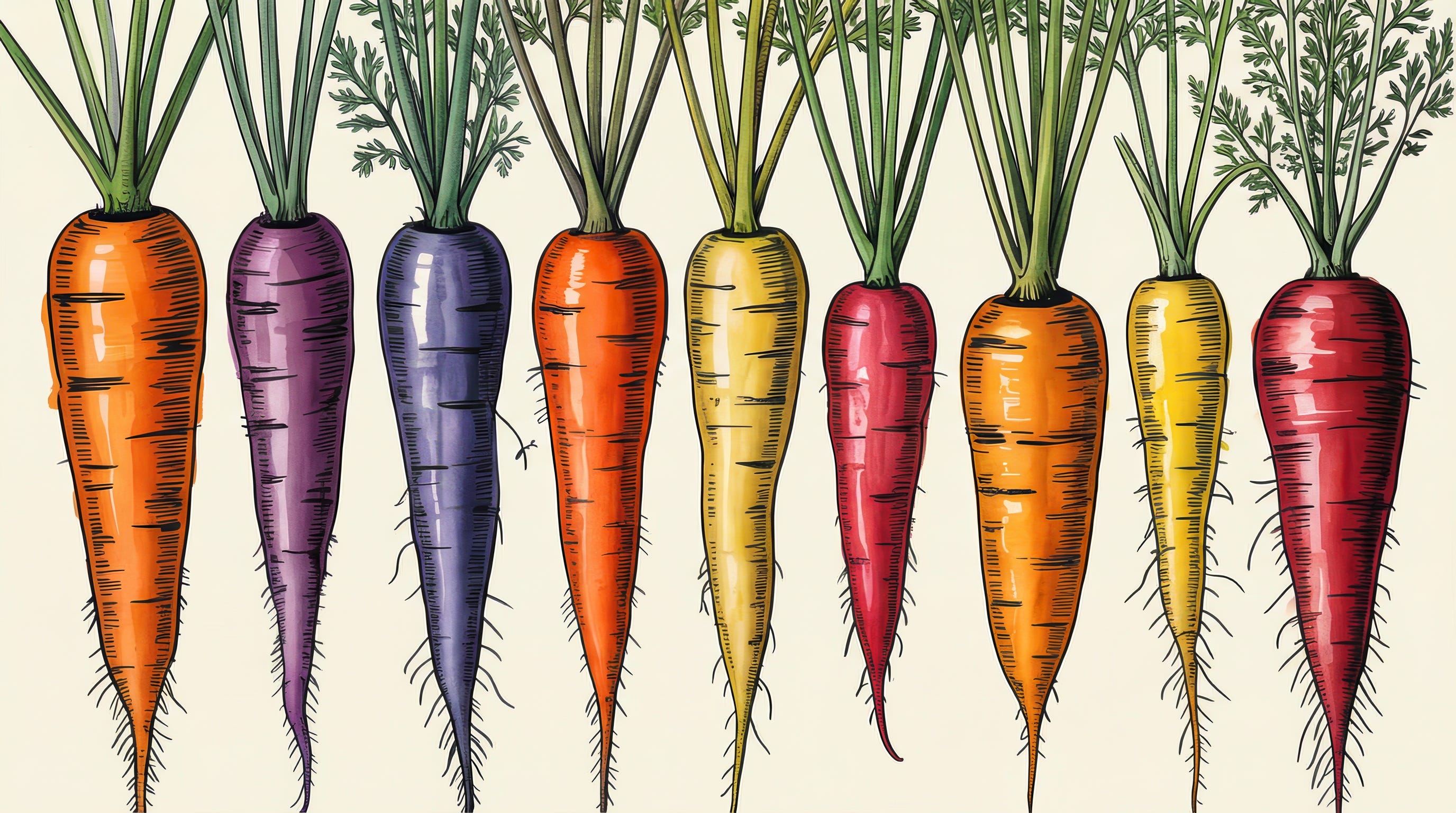
Most people don’t know this, but carrots weren’t always mainly orange.
The original wild carrots were white, tough, and bitter.¹ When people first domesticated carrots in Central Asia around 900 CE, they were purple and yellow.² Those colors were grown for centuries across Asia and the Mediterranean.³ Cultivated carrots spread to Spain in the 1100s via the Middle East and North Africa.⁴ Purple, white, and yellow carrots were brought into southern Europe in the 14th century and were widely grown across Europe into the 16th century.⁵
By the 1500s and 1600s, Dutch growers were selecting and breeding orange carrots. The orange color came from a genetic mutation, probably from crossing yellow and red varieties.⁶ Dutch farmers had developed exceptional agricultural expertise by the 16th century, and they were one of the main agricultural forces of that era.⁷ The mild, wet climate of the Netherlands suited orange carrots particularly well.⁸
The orange carrot grew better than purple and yellow varieties in Dutch conditions. It was more yielding, stable, uniform, and reliable.⁹ Dutch merchants spread the orange produce across Europe. Places like France, Germany, and England received orange carrots first, liked them, and they became the norm.¹⁰
The orange color lined up nicely with the royal House of Orange. There’s a popular claim that orange carrots were bred specifically to honor William of Orange, who led the Dutch revolt against Spanish rule starting in 1566.¹¹ But there’s little evidence for this beyond oral tradition and the timing.¹² What likely happened is that orange carrots were later used by the Dutch state to reinforce the nation’s orange color symbolism after they had already become popular.¹³
Those orange carrots became more uniform, reliable, and easy to market. The orange carrot is colored by alpha- and beta-carotene, which makes it the richest crop source of vitamin A in the American diet.¹⁴ The genes for color and genes for preferred flavors aren’t connected, so the orange color wasn’t selected for nutrition—it was selected for appearance.¹⁵
And many people began treating the older colors as lesser. Purple carrots turn brown when cooked, which made them unpopular with chefs despite being ornamental in raw salads.¹⁶ The violet carrot disappeared from American seed catalogs by the late 19th century.¹⁷ White carrots survived into the 19th century but were often relegated to animal feed.¹⁸
Late in the 20th century, growers and chefs started bringing back purple, yellow, and white carrots. Southern Exposure Seed Exchange began offering purple carrots again in 1991.¹⁹ Heritage carrots became a marketing method for traditional varieties grown by specialty producers.²⁰ Consumers valued them for diversity, colors, and stronger flavor over commercial varieties.²¹
Today, purple carrots are enjoying a revival. Modern interest in heirloom vegetables, nutrient density, and culinary novelty has led farmers’ markets and specialty grocery stores to reintroduce them.²² Chefs prize them for striking color in salads, pickles, and roasted dishes.²³ Their anthocyanin content gives them additional antioxidant benefits compared to orange carrots.²⁴
In 2005, Dr. Phillip Simon and others at the USDA developed Cosmic Purple carrots with bright purple skin and yellow-orange insides.²⁵ The carrot genome was fully sequenced in 2016, revealing that the “Y” gene is responsible for the difference between white carrots and yellow or orange carrots.²⁶
In the end, the carrot didn’t choose this color. Humans did. And like a father to a spoiled child, nature said yes.
Sources
Wikipedia contributors. “Carrot.” Wikipedia. https://en.wikipedia.org/wiki/Carrot
“History of Carrots - A brief summary and timeline.” World Carrot Museum. http://www.carrotmuseum.co.uk/history.html
“History of Carrots - A brief summary and timeline.” World Carrot Museum. http://www.carrotmuseum.co.uk/history.html
“History of Carrots - A brief summary and timeline.” World Carrot Museum. http://www.carrotmuseum.co.uk/history.html
“History of Carrots - A brief summary and timeline.” World Carrot Museum. http://www.carrotmuseum.co.uk/history.html
“A Brief History of Carrot Colors & Heirloom Varieties.” CanningCrafts, February 9, 2023. https://canningcrafts.com/blogs/news/a-brief-history-of-carrot-colors
“Are carrots orange because of a Dutch revolutionary?” Live Science, September 5, 2020. https://www.livescience.com/why-are-carrots-orange.html
“Are carrots orange because of a Dutch revolutionary?” Live Science, September 5, 2020. https://www.livescience.com/why-are-carrots-orange.html
“Are carrots orange because of a Dutch revolutionary?” Live Science, September 5, 2020. https://www.livescience.com/why-are-carrots-orange.html
“Are carrots orange because of a Dutch revolutionary?” Live Science, September 5, 2020. https://www.livescience.com/why-are-carrots-orange.html
Wikipedia contributors. “Carrot.” Wikipedia. https://en.wikipedia.org/wiki/Carrot
Wikipedia contributors. “Carrot.” Wikipedia. https://en.wikipedia.org/wiki/Carrot
“Are carrots orange because of a Dutch revolutionary?” Live Science, September 5, 2020. https://www.livescience.com/why-are-carrots-orange.html
“Carrot genome paints picture of domestication, could help improve crops.” UW-Madison News, May 9, 2016. https://news.wisc.edu/carrot-genome-paints-picture-of-domestication-could-help-improve-crops/
“Carrot genome paints picture of domestication, could help improve crops.” UW-Madison News, May 9, 2016. https://news.wisc.edu/carrot-genome-paints-picture-of-domestication-could-help-improve-crops/
“Heirloom Carrot Varieties.” Mother Earth News, December 22, 2025. https://www.motherearthnews.com/organic-gardening/heirloom-carrot-varieties-zewz1303zsch/
“Heirloom Carrot Varieties.” Mother Earth News, December 22, 2025. https://www.motherearthnews.com/organic-gardening/heirloom-carrot-varieties-zewz1303zsch/
“History of Carrots - A brief summary and timeline.” World Carrot Museum. http://www.carrotmuseum.co.uk/history.html
“Heirloom Carrot Varieties.” Mother Earth News, December 22, 2025. https://www.motherearthnews.com/organic-gardening/heirloom-carrot-varieties-zewz1303zsch/
“Heritage Carrots Information and Facts.” Specialty Produce. https://specialtyproduce.com/produce/Heritage_Carrots_25258.php
“Heritage Carrots Information and Facts.” Specialty Produce. https://specialtyproduce.com/produce/Heritage_Carrots_25258.php
“Carrots Were Originally Purple, Not Orange.” The Prodigious, August 9, 2025. https://theprodigious.com/carrots-were-originally-purple-not-orange/
“Carrots Were Originally Purple, Not Orange.” The Prodigious, August 9, 2025. https://theprodigious.com/carrots-were-originally-purple-not-orange/
“Carrots Were Originally Purple, Not Orange.” The Prodigious, August 9, 2025. https://theprodigious.com/carrots-were-originally-purple-not-orange/
“Purple, Circle, & Black Carrots Galore!” Kellogg Garden Organics, September 8, 2021. https://kellogggarden.com/blog/gardening/black-carrots-circle-carrots-purple-carrots-galore/
“Carrot genome paints picture of domestication, could help improve crops.” UW-Madison News, May 9, 2016. https://news.wisc.edu/carrot-genome-paints-picture-of-domestication-could-help-improve-crops/