

The Almond Industry Is Sinking California. Literally.
There’s a number attached to every almond you’ve ever eaten. It’s never been on the label.
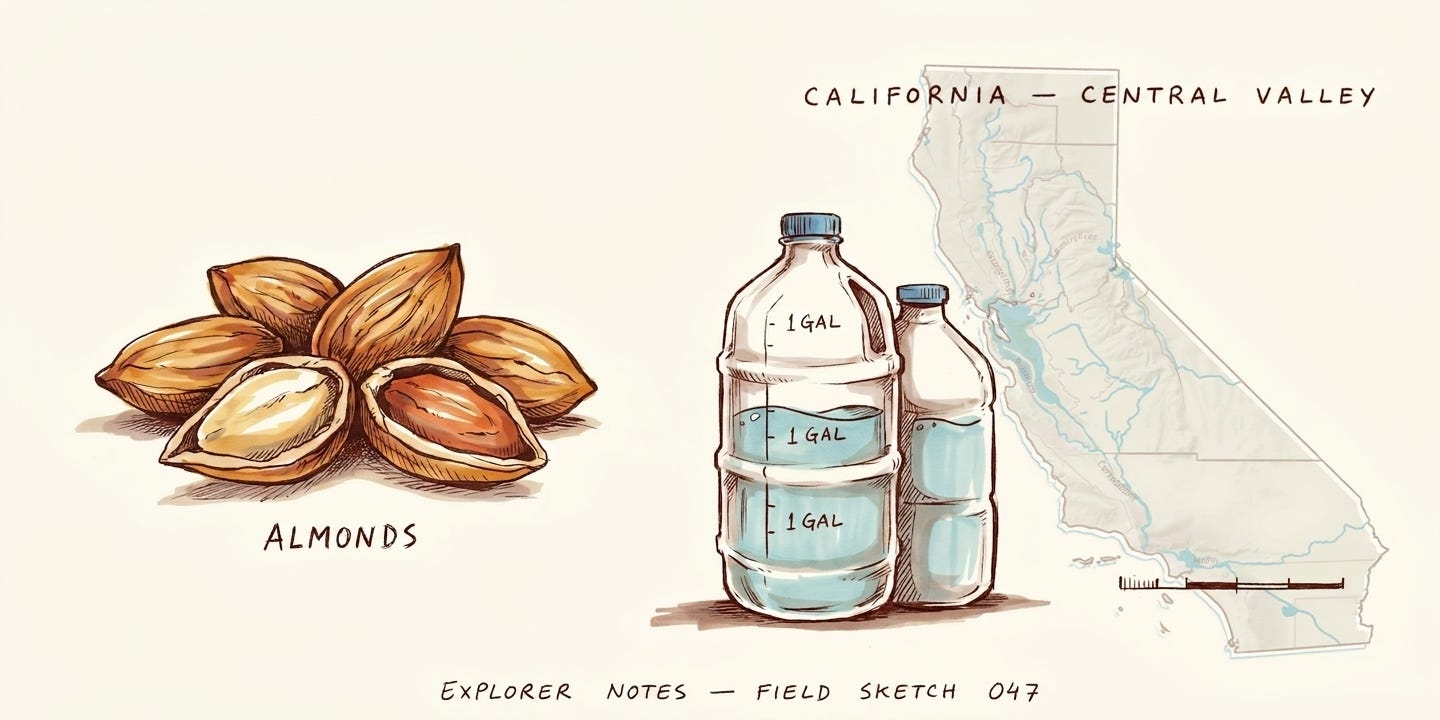
A single almond takes about 1.1 gallons of water to produce. A handful takes about 10. A jar of almond butter takes around 3,000. These numbers don’t change based on where you bought it, what brand it was, or what the packaging said about sustainability. They’re fixed into the biology of the tree and the climate of the one place on Earth that grows 80% of the world’s supply.
California doesn’t have enough rain to grow almonds. It never did.
The water comes from underground. California’s Central Valley sits on top of one of the largest groundwater basins in the western United States, aquifers that accumulated over thousands of years of snowmelt and rainfall seeping down through layers of rock and sediment. Farmers drill wells and pump that water up to irrigate their orchards. The almonds grow. The water doesn’t come back.
In 1997, California had 442,000 bearing acres of almond orchards. By 2022 that number had grown to 1.3 million acres. More than tripled in 25 years. Every new acre planted in a drought state needed a new well. Every new well pulled more water from aquifers that were already running a deficit of nearly 2 million acre-feet per year.
Then, of course, the ground started reacting to to this, and the reaction wasn’t good…
Since the 1920s, excessive groundwater pumping has caused land in sections of California’s San Joaquin Valley to sink by as much as 28 feet. A government report from 1999 described the total historical subsidence as “one of the single largest alterations of the land surface attributed to humankind.” NASA commissioned satellite radar data from its Jet Propulsion Laboratory confirmed it’s still happening. Parts of the valley are sinking at rates as high as 2 feet per year. A Stanford study published in 2024 found the average rate of sinking for the entire valley reached nearly an inch per year between 2006 and 2022, with more than 4,000 square miles dropping by over 12 inches.
...The ground is collapsing from the inside. Slowly. Measurably. Visibly… from space.
The sinking has already taken out thousands of wells. Public ones. Private ones. Wells people were depending on. State and federal water agencies have spent an estimated 100 million dollars on related repairs since the 1960s. When an aquifer collapses the space it held is gone permanently. The water that once filled it has no place to go back to. The valley that’s been feeding America for a hundred years is slowly compressing under the weight of its own production.
None of this is on the label of the almonds in your kitchen right now.
The bag says how many grams of protein per serving. It says whether they’re raw or roasted, salted or unsalted, whole or slivered. It says where to store them and when they expire.
It doesn’t say 1.1 gallons per nut. It doesn’t say the valley that grew them sank another inch last year. It doesn’t say the aquifer underneath it took thousands of years to fill and is leaving on a timeline nobody alive today will see the end of.
Which is pretty insane.
Sources
Food Revolution Network. “Almonds & Sustainability: The Truth About Almonds & Water Use.” https://foodrevolution.org/blog/almonds-sustainability/
The Green Shot. “Almond Milk’s Environmental Impact: The Truth.” https://www.thegreenshot.io/uncategorized/why-almond-milk-is-bad-for-the-environment/
ScienceDirect. “Water-Indexed Benefits and Impacts of California Almonds.” https://www.sciencedirect.com/science/article/pii/S1470160X17308592
USDA NASS. “2025 California Almond Forecast.” https://www.nass.usda.gov/Statistics_by_State/California/Publications/Specialty_and_Other_Releases/Almond/Forecast/202505almpd.pdf
NASA Earth Observatory. “San Joaquin Valley is Still Sinking.” https://earthobservatory.nasa.gov/images/89761/san-joaquin-valley-is-still-sinking
NASA Science. “San Joaquin Valley is Still Sinking.” https://science.nasa.gov/?p=1134794
Stanford University. “Groundwater Pumping Drives Rapid Sinking in California.” https://news.stanford.edu/stories/2024/11/groundwater-pumping-drives-rapid-sinking-in-california
Central Valley Flood Protection Board. “NASA Data Shows Groundwater Pumping Causing Subsidence.” https://cvfpb.ca.gov/news/nasa-data-shows-groundwater-pumping-causing-subsidence-damaging-water-infrastructure/
EcoMotion. “Almond Farming and California Water.” https://ecomotion.us/almond-farming-and-california-water/
Grist. “California Almonds Drink Up 3 Years Worth of LA’s Water Use.” https://grist.org/food/california-almonds-los-angeles-drought/
YIP Institute. “California Almonds: Weighing Economic Impact vs. Water Sustainability.” https://yipinstitute.org/policy/california-almonds-weighing-economic-impact-vs-water-sustainability/
Ohio State University. “Using Satellites to Track Groundwater Depletion in California.” https://news.osu.edu/using-satellites-to-track-groundwater-depletion-in-california/