

The Cloned Crop That Could Collapse
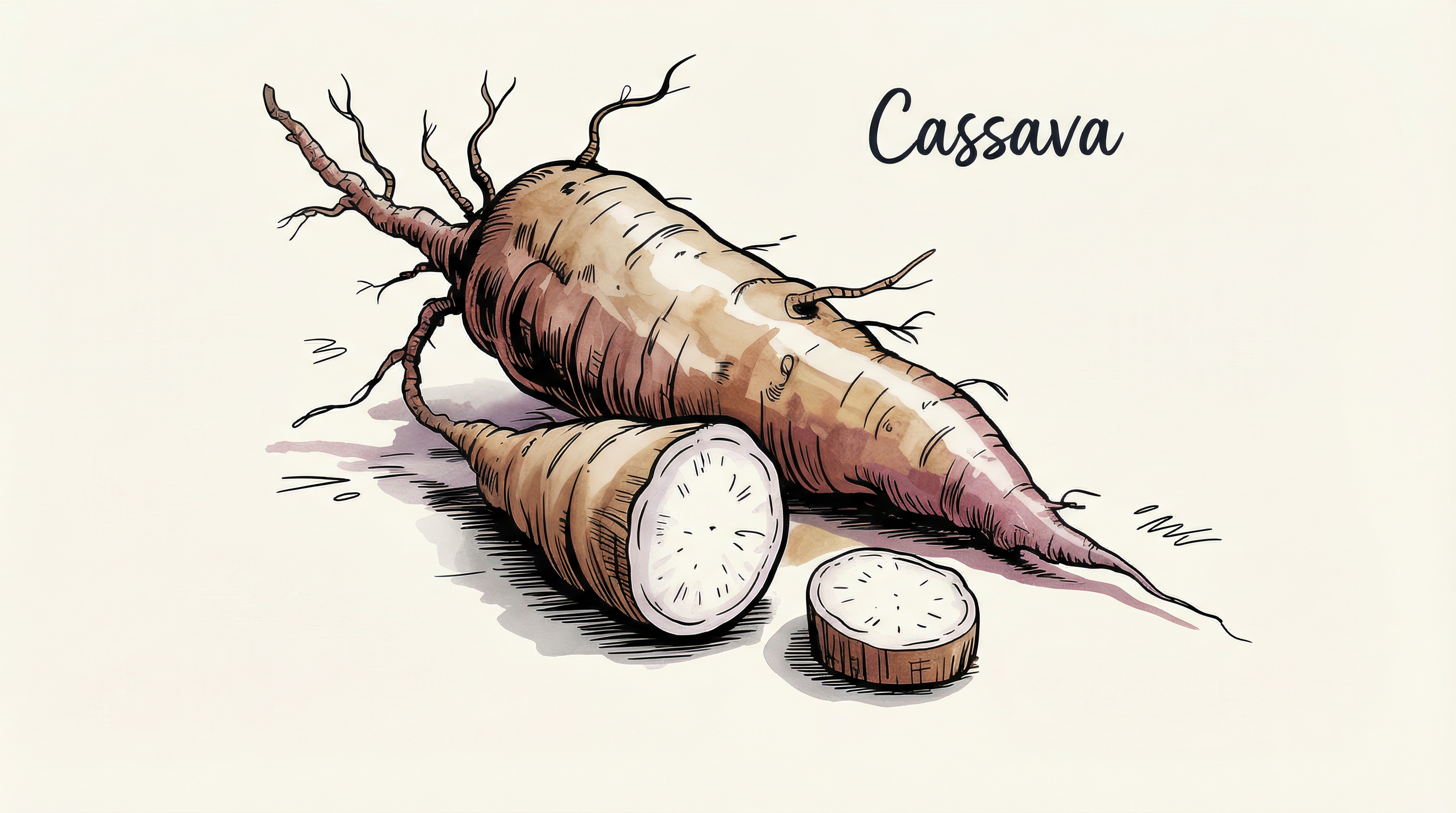
One of the world’s most eaten crops that people worry could collapse is cassava.
Cassava feeds more than 800 million people on this planet.¹ It’s a vital carbohydrate source, particularly in Sub-Saharan Africa, where it provides more calories per hectare than most other staple crops.² The tubers can stay in the ground for up to three years without spoiling, making it a critical food security crop.³
Most cassava in farmers’ fields is grown from cuttings, so many plants are actually clones of existing plants.⁴ They’re reproduced through vegetative propagation, where a piece of the stem grows into an entirely new plant.⁵ Farmers select healthy cassava stems from mature plants about 2 to 4cm thick, let them dry for about 10 days, then cut them into pieces 10 to 20 centimeters long with at least two or three nodes.⁶ Those nodes are where new roots and shoots form.⁷
That new plant is basically a clone of the old one. Genetically identical.⁸ A typical mature cassava plant produces 10 to 30 stakes per year sized at about 25cm, meaning a single plant can theoretically produce 10 to 30 genetic copies.⁹ If stakes are reduced to include only one or two nodes, a single plant can produce 100 to 200 clones per year.¹⁰
This is part of how cassava can reliably feed whole communities year after year. Vegetative propagation results in genetically identical plants, ensuring that offspring carry the exact traits of the parent plant.¹¹ This preserves desirable characteristics in cassava varieties.¹² Farmers can replicate proven varieties without the genetic variation that comes from seed-based reproduction.¹³
But because it often bypasses sexual reproduction, many fields end up with very little genetic diversity.¹⁴ Seeds result in highly heterogeneous offspring that no longer possess the desirable traits of the seed parent.¹⁵ So cassava propagation is done mostly through stem cuttings.¹⁶ But this means lots of plants can share the same weaknesses.¹⁷
So one new disease or pest can sometimes spread through cassava very quickly.¹⁸ Cassava production in East Africa is severely affected by cassava brown streak disease, caused by cassava brown streak virus and Ugandan cassava brown streak virus.¹⁹ The disease first appeared in northeast Tanzania in 1936.²⁰ For 70 years it was restricted to coastal East Africa.²¹ Then at the turn of the 21st century, it re-emerged further inland around Lake Victoria and spread through many East and Central African countries.²²
Cassava mosaic disease is the other major threat. Caused by cassava mosaic begomoviruses, it’s endemic wherever cassava is grown in Africa.²³ Both diseases are transmitted by the whitefly Bemisia tabaci, though brown streak viruses are inefficiently transmitted compared to mosaic viruses.²⁴
The genetic uniformity created by vegetative propagation makes entire fields susceptible.²⁵ Most cassava varieties grown in Africa are susceptible to the viruses causing both diseases.²⁶ When one plant gets infected, the disease can spread rapidly through genetically identical neighbors.²⁷ Cassava brown streak virus has a rapidly evolving genome, with nonsynonymous substitutions occurring across the entire genome, allowing it to overcome resistance faster than other plant viruses.²⁸
For a long time, the main way to spread cassava was to share cuttings with your neighbors.²⁹ This tradition enabled cassava to spread across Africa and become a dietary staple.³⁰ But when almost everyone grows the same few clones, that tradition can also make the whole crop more vulnerable.³¹
Breeding programs have tried crossing cassava with its wild relative Manihot glaziovii to introduce disease resistance genes.³² This approach was initiated in 1937 in Amani, Tanzania.³³ Some of these inter-specific hybrids are now considered farmer varieties or landraces, forming an important genepool for disease resistance breeding.³⁴ But developing broad-spectrum resistance against both diseases simultaneously has proven extremely difficult.³⁵
Which means the crop that feeds 800 million people is propagated through a method that creates genetic uniformity, making it inherently vulnerable to rapidly evolving diseases. The very trait that makes cassava reliable—its ability to clone itself perfectly—is also what makes its collapse possible.
Sources
“Genome-wide association study of cassava brown streak disease resistance in cassava germplasm conserved in South America.” Nature Scientific Reports, October 4, 2024. https://www.nature.com/articles/s41598-024-74161-6
“An efficient method of propagating cassava plants using aeroponic culture.” Journal of Crop Improvement. https://www.tandfonline.com/doi/abs/10.1080/15427528.2019.1673271
“Cut, Root, and Grow: Simplifying Cassava Propagation to Scale.” PMC. https://pmc.ncbi.nlm.nih.gov/articles/PMC10893366/
“Unlocking Cassava’s Cloning Potential: A Guide to Asexual Propagation with Stem Cuttings.” Greenhills Cassava Farmstead, November 8, 2023. https://greenhillsfarmstead.com/unlocking-cassavas-cloning-potential-a-guide-to-asexual-propagation-with-stem-cuttings/
“Vegetative reproduction.” Wikipedia, 1 month ago. https://en.wikipedia.org/wiki/Vegetative_reproduction
“Unlocking Cassava’s Cloning Potential: A Guide to Asexual Propagation with Stem Cuttings.” Greenhills Cassava Farmstead, November 8, 2023. https://greenhillsfarmstead.com/unlocking-cassavas-cloning-potential-a-guide-to-asexual-propagation-with-stem-cuttings/
“Unlocking Cassava’s Cloning Potential: A Guide to Asexual Propagation with Stem Cuttings.” Greenhills Cassava Farmstead, November 8, 2023. https://greenhillsfarmstead.com/unlocking-cassavas-cloning-potential-a-guide-to-asexual-propagation-with-stem-cuttings/
“Asexual Reproduction: Various Methods Of Vegetative Propagation.” ClassNotes.ng, March 11, 2025. https://classnotes.ng/lesson/asexual-reproduction-various-methods-of-vegetative-propagation/
“Chapter 15: Cassava Breeding.” Crop Improvement, June 14, 2023. https://iastate.pressbooks.pub/cropimprovement/chapter/cassava-breeding/
“Chapter 15: Cassava Breeding.” Crop Improvement, June 14, 2023. https://iastate.pressbooks.pub/cropimprovement/chapter/cassava-breeding/
“Unlocking Cassava’s Cloning Potential: A Guide to Asexual Propagation with Stem Cuttings.” Greenhills Cassava Farmstead, November 8, 2023. https://greenhillsfarmstead.com/unlocking-cassavas-cloning-potential-a-guide-to-asexual-propagation-with-stem-cuttings/
“Unlocking Cassava’s Cloning Potential: A Guide to Asexual Propagation with Stem Cuttings.” Greenhills Cassava Farmstead, November 8, 2023. https://greenhillsfarmstead.com/unlocking-cassavas-cloning-potential-a-guide-to-asexual-propagation-with-stem-cuttings/
“Chapter 15: Cassava Breeding.” Crop Improvement, June 14, 2023. https://iastate.pressbooks.pub/cropimprovement/chapter/cassava-breeding/
“Vegetative reproduction.” Wikipedia, 1 month ago. https://en.wikipedia.org/wiki/Vegetative_reproduction
“Chapter 15: Cassava Breeding.” Crop Improvement, June 14, 2023. https://iastate.pressbooks.pub/cropimprovement/chapter/cassava-breeding/
“Chapter 15: Cassava Breeding.” Crop Improvement, June 14, 2023. https://iastate.pressbooks.pub/cropimprovement/chapter/cassava-breeding/
“Vegetative reproduction.” Wikipedia, 1 month ago. https://en.wikipedia.org/wiki/Vegetative_reproduction
“Vegetative reproduction.” Wikipedia, 1 month ago. https://en.wikipedia.org/wiki/Vegetative_reproduction
“Genome-wide association study of cassava brown streak disease resistance in cassava germplasm conserved in South America.” Nature Scientific Reports, October 4, 2024. https://www.nature.com/articles/s41598-024-74161-6
“Cassava brown streak disease: historical timeline, current knowledge and future prospects.” PMC. https://pmc.ncbi.nlm.nih.gov/articles/PMC5947582/
“Cassava brown streak disease: historical timeline, current knowledge and future prospects.” PMC. https://pmc.ncbi.nlm.nih.gov/articles/PMC5947582/
“Cassava brown streak disease: historical timeline, current knowledge and future prospects.” PMC. https://pmc.ncbi.nlm.nih.gov/articles/PMC5947582/
“Frontiers | Developing broad-spectrum resistance in cassava against viruses causing the cassava mosaic and the cassava brown streak diseases.” Frontiers, January 2, 2023. https://www.frontiersin.org/journals/plant-science/articles/10.3389/fpls.2023.1042701/full
“Frontiers | Developing broad-spectrum resistance in cassava against viruses causing the cassava mosaic and the cassava brown streak diseases.” Frontiers, January 2, 2023. https://www.frontiersin.org/journals/plant-science/articles/10.3389/fpls.2023.1042701/full
“Vegetative reproduction.” Wikipedia, 1 month ago. https://en.wikipedia.org/wiki/Vegetative_reproduction
“Epidemiological Analysis of Cassava Mosaic and Brown Streak Diseases, and Bemisia tabaci in the Comoros Islands.” PMC. https://pmc.ncbi.nlm.nih.gov/articles/PMC9608219/
“Vegetative reproduction.” Wikipedia, 1 month ago. https://en.wikipedia.org/wiki/Vegetative_reproduction
“Cassava brown streak virus has a rapidly evolving genome: implications for virus speciation, variability, diagnosis and host resistance.” Nature Scientific Reports, November 3, 2016. https://www.nature.com/articles/srep36164
“Chapter 15: Cassava Breeding.” Crop Improvement, June 14, 2023. https://iastate.pressbooks.pub/cropimprovement/chapter/cassava-breeding/
“Unlocking Cassava’s Cloning Potential: A Guide to Asexual Propagation with Stem Cuttings.” Greenhills Cassava Farmstead, November 8, 2023. https://greenhillsfarmstead.com/unlocking-cassavas-cloning-potential-a-guide-to-asexual-propagation-with-stem-cuttings/
“Vegetative reproduction.” Wikipedia, 1 month ago. https://en.wikipedia.org/wiki/Vegetative_reproduction
“Genome-wide association study of cassava brown streak disease resistance in cassava germplasm conserved in South America.” Nature Scientific Reports, October 4, 2024. https://www.nature.com/articles/s41598-024-74161-6
“Field evaluation of selected cassava genotypes for cassava brown streak disease based on symptom expression and virus load.” PMC. https://pmc.ncbi.nlm.nih.gov/articles/PMC4304613/
“Field evaluation of selected cassava genotypes for cassava brown streak disease based on symptom expression and virus load.” PMC. https://pmc.ncbi.nlm.nih.gov/articles/PMC4304613/
“Frontiers | Developing broad-spectrum resistance in cassava against viruses causing the cassava mosaic and the cassava brown streak diseases.” Frontiers, January 2, 2023. https://www.frontiersin.org/journals/plant-science/articles/10.3389/fpls.2023.1042701/full