

The Dark Story In Your Kitchen...
The nutmeg in your kitchen spice rack was worth more than its weight in gold and possibly… a human life.
At the height of the spice trade, the 1.5-ounce bottle sitting in your cabinet would have been worth about $2,800 at today’s prices. Europeans believed it could cure the plague and do things like boost virility. The demand was enormous but the supply came from one place on Earth and one place only.
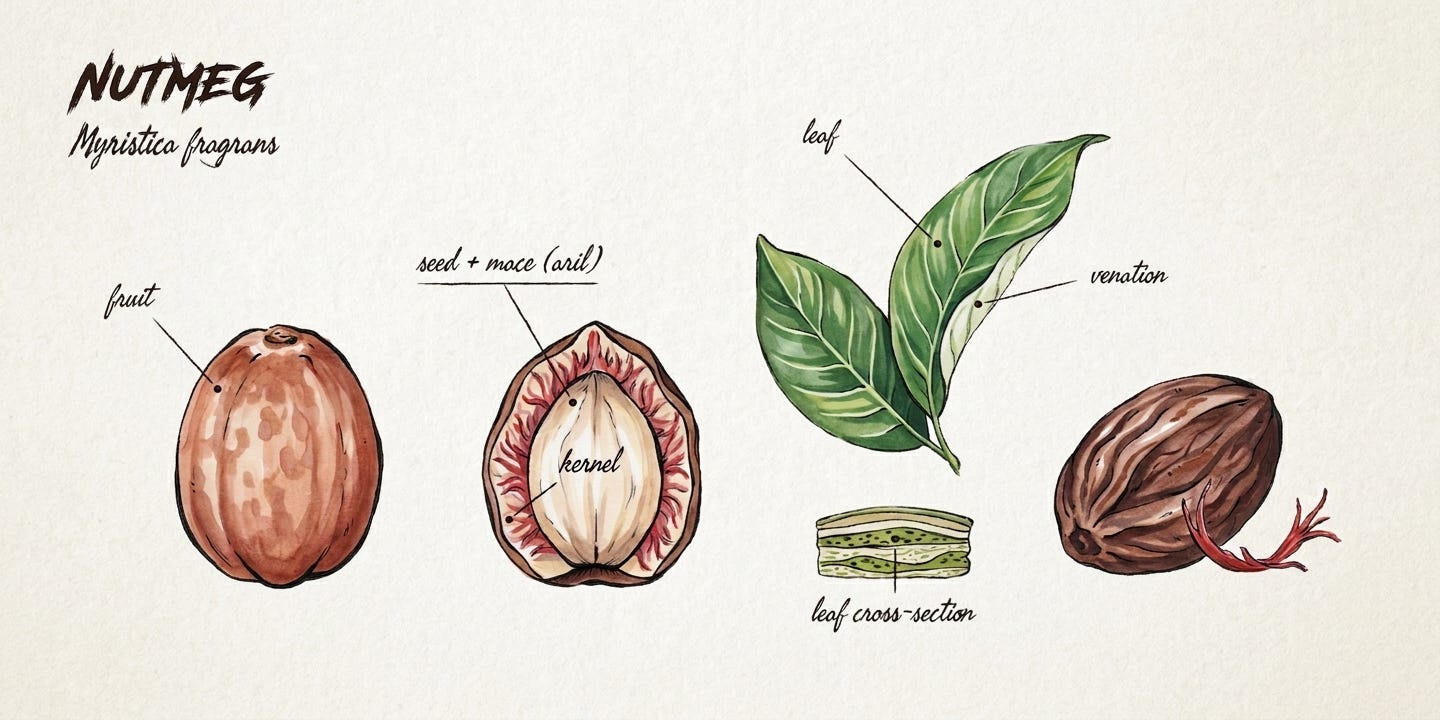
Nine small islands in the Banda Sea, in what is now eastern Indonesia, were the only location where nutmeg grew. The Banda Islands occupy an area of just five miles by twenty miles of ocean. The people who lived there, the Bandanese, had built an entire civilization around the spice trade, a society of roughly 15,000 free traders who had been cultivating and selling nutmeg to Arab, Javanese, and Chinese merchants for centuries before any European ship ever arrived.
The Dutch decided they needed to own all of it.
The VOC, the Dutch East India Company, quickly understood that controlling nutmeg required maintaining high prices in Europe and cheap, regulated supply in the Banda Islands. The Bandanese, who had been trading freely with whoever offered the best price, kept selling to English merchants too. The Dutch tried treaties. The Bandanese ignored them... The Dutch tried to build fortresses. The Bandanese burned them… After twenty years of failed attempts to establish a monopoly, the VOC’s Governor-General Jan Pieterszoon Coen figured there was only one solution.
Coen had a personal grudge against the Bandanese for twelve years, since he almost lost his life during an earlier confrontation on the islands. In February 1621 he arrived with a fleet of fifteen ships carrying 1,655 soldiers, about 100 Japanese mercenaries, and 286 enslaved people serving as rowers and porters. He attacked the largest island first… and within weeks the VOC had seized the entire group of small islands.
What followed after that was the systematic destruction of nearly an population of people.
Forty-four Bandanese community leaders, the Orangkaya, all of them… captured. Eight of the most influential people in the islands were all put in bamboo cages outside Fort Nassau and executed by the Japanese mercenaries, their bodies cut into pieces. The remaining 36 were beheaded, their heads impaled on bamboo stakes and displayed publicly. Nearly 800 relatives of the executed leaders, old men, women, and children, were shipped to Batavia and put to work as slaves. The rest of the population was either hunted across the islands or ran into the hills. Out of an estimated 15,000 Bandanese, less than 1,000 survived.
The VOC then repopulated the islands with imported laborers and former Dutch soldiers, divided the land into plantations, and ran the nutmeg operation as a company asset. A small number of Bandanese were eventually allowed to return because their knowledge of nutmeg cultivation was almost literally indispensable. So… they were forced to help the new plantation owners.
The monopoly held for decades and the Dutch considered the whole operation a commercial success. And in a way… it was.
There is one detail that didnt make it into the history books most people read. While all of this was happening in the Banda Sea, the English still controlled one small island in the archipelago called Run. The Dutch wanted it. In 1667, the Treaty of Breda formally settled the matter. The Dutch gave the English their claim to a marshy colony on the other side of the world. The English gave the Dutch Run Island. The colony the Dutch handed over was called New Amsterdam… and the English renamed it New York.
The Dutch thought they had won, because at the time Manhattan was considered far less valuable than a nutmeg island.
The Banda Islands today are quiet. The nutmeg trade that made them the most strategically important piece of land on Earth for a hundred years is mostly gone, displaced by plantations in Grenada and elsewhere once the Dutch monopoly collapsed. Run Island, the island at the center of the trade for Manhattan, has no movie theater and no wifi. Most people alive today have never heard of it.
The 15,000 people who built the civilization that made all of it possible have no monument. No national memorial. No line in most history textbooks. What they have is a spice rack in your kitchen and a city that exists because of the island their ancestors died on.
Which is… pretty insane.
Sources
Nu Products Seasoning. “Nutmeg: The Spice of Kings.” https://www.nuproductsseasoning.com/behind-the-spice/nutmeg-the-spice-of-kings/
Dhont, F. (2023). “Genocide in the Spice Islands.” Cambridge World History of Genocide, Vol. II. Cambridge University Press. https://doi.org/10.1017/9781108765480.009
Tirto/Historia. “The Massacre of the Bandanese.” https://historibersama.com/the-massacre-of-the-bandanese-tirto/
Pala: Nutmeg Tales of Banda. “1621 Article.” https://pala.westfriesmuseum.nl/1621-2/1621-article/?lang=en
Pala: Nutmeg Tales of Banda. “Exploitation.” https://pala.westfriesmuseum.nl/exploitatie/?lang=en
Tandfonline. “Debating Natural Law in the Banda Islands, 1609-1621.” https://www.tandfonline.com/doi/full/10.1080/01916599.2015.1101216
Diaspora Co. “More Than Pumpkin Spice: The True Cost of Nutmeg.” https://www.diasporaco.com/blogs/journal/more-than-pumpkin-spice-the-true-cost-of-the-craze-for-nutmeg
HowStuffWorks. “Did the Dutch Really Trade Manhattan for Nutmeg?” https://history.howstuffworks.com/history-vs-myth/nutmeg-new-netherland.htm
Southeast Asia Society. “Why the Dutch Traded Manhattan for this Indonesian Island.” https://seasoc.org/2023/03/03/why-the-dutch-traded-manhattan-for-this-indonesian-island-in-1667/
Spice Islands Blog. “The Forgotten Indonesian Island That Was Swapped for Manhattan.” https://spiceislandsblog.com/2017/07/30/the-forgotten-indonesian-island-that-was-swapped-for-manhattan/