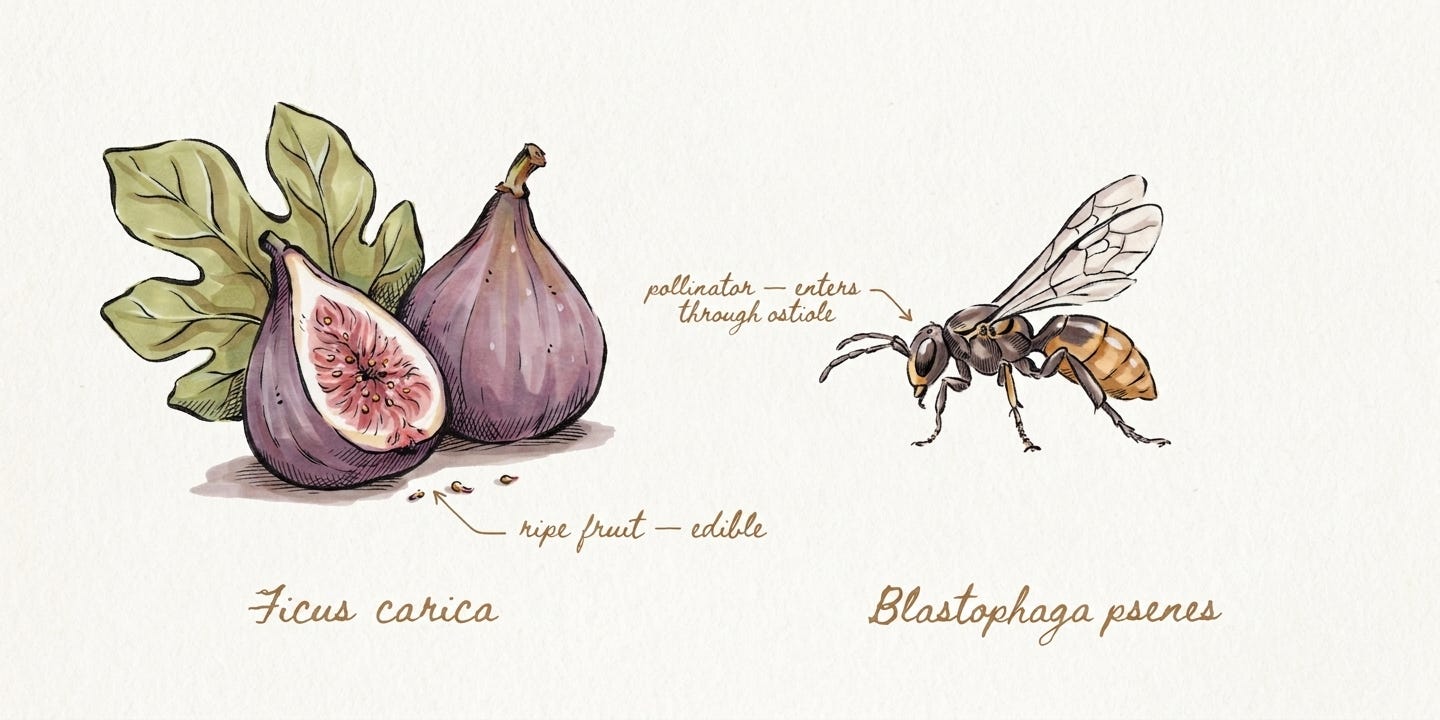
The Fruit That Dissolves Animals Inside Itself
A fig tree has been dissolving wasps inside its fruit for 75 million years.
That number isn’t really an estimate, it’s from genomic analysis published in Nature Communications, comparing the histories of fig trees and fig wasps across every major branch of both species. 75 million years of the same relationship, unbroken. To put that into perspective, that’s about 10 million years before the mass extinction that wiped out the dinosaurs.
A fig isn’t a fruit in the way most people think about fruit. It’s a hollow chamber called a syconium. Its lined on the inside with a bunch of tiny flowers that can never really be reached from outside. There’s also no opening wide enough for a bee. No surface exposed to the wind.
So the fig solved the problem of how to get pollinated in one of the strangest ways in the plant kingdom… it grew a door just small enough for one specific animal.
And that animal… is the fig wasp.
A female fig wasp, carrying pollen from the fig she was born in, finds a new fig by following a chemical signal the tree releases when its flowers are ready. She can detect that signal from literal miles away. They land on the fig, finds the small opening at the base, and crawls inside. That passage is so narrow that she loses her wings and antennae getting through it. Which ultimately means she can’t get back out.
Inside the fig she travels around the dark chamber, spreading pollen on the flowers as she moves, while also laying her eggs in others. When she’s done… she dies. The fig is her tomb and she went in knowing, in whatever way an insect knows anything, that she wasn’t coming back out.
Then… the fig does something that took researchers years to fully document.