

The Fruit That Traveled From Africa and Became India's Sour Heart
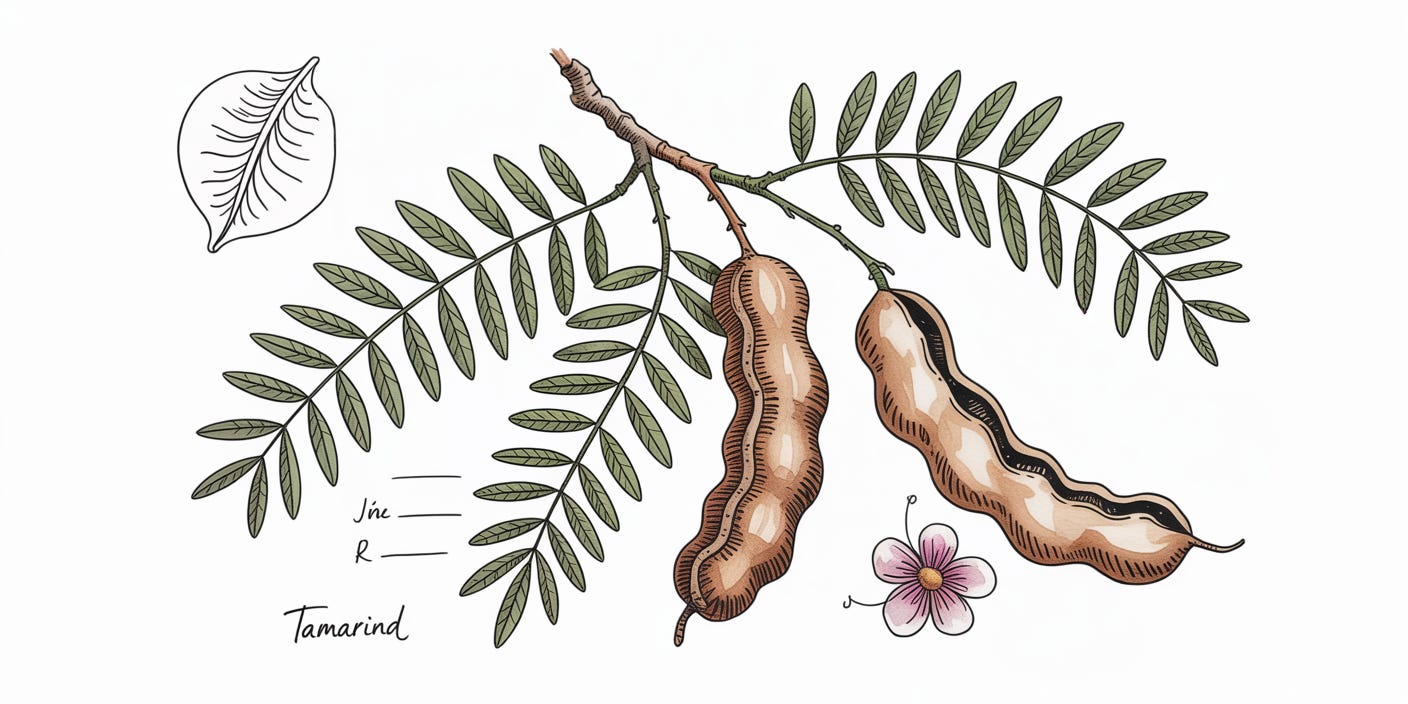
One of the oldest fruits ever eaten by humans is tamarind. Ancient Egyptians had it. The Greeks knew it in the 4th century BC. It’s been in human hands for a very, very long time.
Tamarind grows at the top of trees that can live 200 years. Some say 200. Some say 300. Either way, they outlast empires. And they can produce more than 400 pounds of fruit per year. One fully developed tree gives you 200 to 250 kilograms annually. That’s a lot of sour.
They grow in these long brittle pods, kinda like peas. Because they’re actually beans. The tamarind is a legume, part of the Fabaceae family. Same family as peas and lentils. The pod looks nothing like a lentil, but botanically, they’re cousins.
The sticky part on the inside tastes like a mix of lemon and caramel. Sour and sweet at the same time. That’s why it’s so commonly used in Indian dishes. In India, tamarind is a foundational flavor. It goes into sambar, rasam, chutneys, curries. It acts as a preservative, a cooling agent, and even a remedy for the itchy mouthfeel you get from eating certain tubers like yam and taro. There’s a saying that tamarind is so central to South Indian food that if you grow up there, you start eating it before you can walk. Actually, that’s not a saying. I just made it up. But it might as well be true.
The part that doesn’t make sense, to me at least… Even though the word tamarind comes from the Arabic name “tamar al-Hind,” which means “date of India,” they’re not actually native to India.
The name is a geographical accident. When the Arabs encountered this fruit, they got it from India. So they called it the Indian date. The name stuck. The scientific name Tamarindus indica does the same thing. Indica means from India. Except it’s not.
Tamarind actually grew wild in East Africa before arriving in India through ancient trade routes. It’s native to tropical Africa, from Sudan down to Mozambique, and parts of Madagascar. It reached India thousands of years ago, probably through human transportation and cultivation. It was introduced so long ago that everyone forgot it wasn’t always there.
But over time, India became one of the biggest cultivators and consumers of tamarind. Today, India produces around 275,500 tons annually. It’s grown extensively in the southern states. It’s in the food, the medicine, the culture. The fruit crossed the ocean and became so deeply Indian that even its name insists it never left.
Which is… pretty insane.
Sources
Wikipedia contributors. (2008). Tamarind: Difference between revisions. Wikipedia. https://en.wikipedia.org/w/index.php?diff=214232234
eCourses. (2012). Tropical & Subtropical Fruits: Fruiting, harvesting and Post harvest handling. IASRI. http://ecoursesonline.iasri.res.in/mod/page/view.php?id=148910
ScienceDirect. Tamarindus indica (Tamarind). Topics in Immunology and Microbiology. https://www.sciencedirect.com/topics/immunology-and-microbiology/tamarind
Sankari, R. Honestly, What Can’t Tamarind Do? Bon Appétit. https://www.bonappetit.com/story/how-to-use-tamarind
Yule, H. & Burnell, A.C. (1903). Hobson-Jobson: A glossary of Colloquial Anglo-Indian Words and Phrases. Digital South Asia Library. https://dsal.uchicago.edu/cgi-bin/app/hobsonjobson_query.py?page=895
Encyclopædia Britannica, Ninth Edition. (1888). Tamarind. Wikisource. https://en.m.wikisource.org/w/index.php?title=Encyclop%C3%A6dia_Britannica,_Ninth_Edition/Tamarind&oldid=12106939
Wikipedia contributors. (2015). Tamarind. Wikipedia via Canada.ca. https://webarchiveweb.wayback.bac-lac.canada.ca/web/20151126131937/https://en.wikipedia.org/wiki/Tamarind
FAO. (2001). Tamarindus indica L. EcoPort. http://easianet.ecoport.org/ep?Plant=2047&entityType=PL****&entityDisplayCategory=versions
Backyard Nature. Tamarind/Tamarindo. StudyRes. https://studyres.com/doc/2070112/--backyard-nature?page=68