

The Most Banned Food in America isn't a nut. It Never Was.
The food you’re most afraid of is the one that was never supposed to be yours.
The peanut kills people as most already know. Schools announce it on the first day of class, airlines say it before the plane even moves, and it’s one of the only foods on the planet that gets its own warning system. And the thing causing all of that… is a bean.
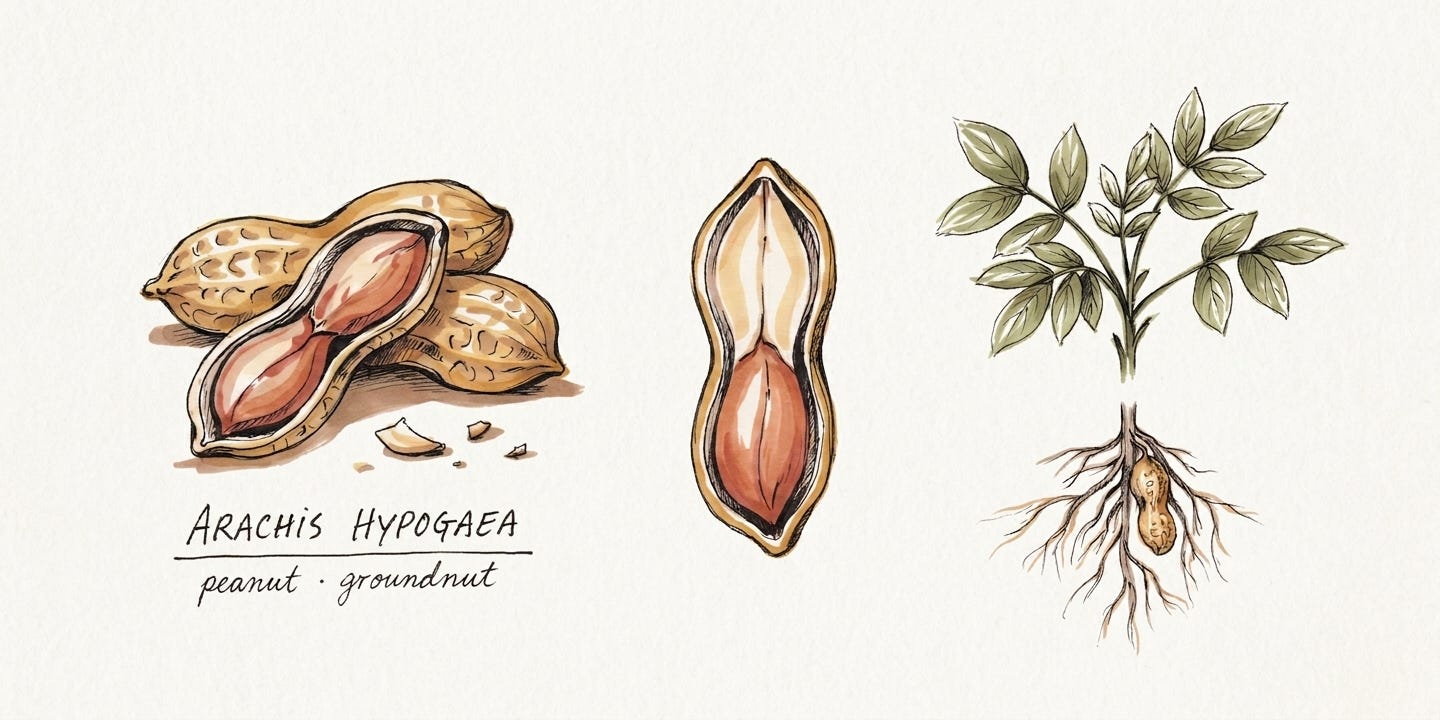
And that’s because they’re actually legumes. A legume, the same family as peas and lentils, and it grows underground by pushing itself into the soil after it flowers. The name ‘peanut’ is something the English language invented because it tasted close enough to something familiar. Before that name existed, the people who actually knew what it was called it nguba, a word from the Kongo language, named for the way it looked, shaped like a kidney. That word traveled across an ocean and became goober, and that’s how it arrived in America — not through any explorer or scientist, but carried by enslaved people on ships crossing the Atlantic, where it was sometimes the only food they were given to stay alive during the crossing.
The crop that would eventually feed an entire nation arrived as survival rations for people being transported against their will. I had to sit with that for a minute.
Once it got here, nobody wanted it. In the early 1800s peanuts were considered food for the poor and feed for livestock, something that you grew if you had nothing else and ate if you had no other choice. The people who were actually growing them were the same people who had carried them back across the ocean, planting them on the edges of plantations built almost entirely around cotton. And cotton, planted in the same fields year after year, was slowly destroying the ground underneath it.
But in 1896 a man named George Washington Carver arrived at Tuskegee Institute in Alabama, and he looked at that exhausted land and told farmers to plant peanuts. Not because of the taste or the nutrition, but because peanuts put nitrogen back into the ground. They pull it from the air and deposit it in the soil, so the land that cotton had been draining for decades could finally start to actually heal itself. Plant peanuts one season and the ground recovers. Plant cotton the next and the yield comes back. It was a solution hiding in the crop that everyone had been ignoring.
The farmers planted peanuts. And then they had more peanuts than anyone knew what to do with.
So Carver went to work at Tuskegee and spent years figuring out what a peanut could actually become… cooking oil, soap, ink, dye, milk, flour, cosmetics, wood stain, and hundreds of other things, 325 different uses. In 1921 he walked into the House Ways and Means Committee in Washington and laid everything out on a table in front of Congress. Candy. Instant coffee. Animal feed. Cooking oil. He had thirty minutes scheduled and yet he kept going for two hours, and they surprisingly let him finish.
When Carver arrived at Tuskegee in 1896, the peanut wasn’t even recognized as a legitimate U.S. crop. By 1940 it was the second largest cash crop in the entire South, behind only the cotton it had helped save.
The crop that arrived as rations for enslaved people, that the rest of the country dismissed as animal feed for decades, that a man born into bondage turned into an industry — that crop is now in your pantry, in your kid’s lunch, banned on airplanes, and announced in schools like a threat. The most feared food in your kitchen is the one that kept this country alive.
Which is pretty insane.
Sources
NPR Illinois. (2014). “A Legume With Many Names: The Story Of ‘Goober.’” https://www.nprillinois.org/equity-justice/2014-04-20/a-legume-with-many-names-the-story-of-goober
Science History Institute. (2026). “George Washington Carver.” https://www.sciencehistory.org/education/scientific-biographies/george-washington-carver/
National Inventors Hall of Fame. “George Washington Carver.” https://www.invent.org/inductees/george-washington-carver
Southern Exposure Seed Exchange. (2020). “The Incredible History of the Peanut.” https://blog.southernexposure.com/2020/05/the-incredible-history-of-the-peanut/
University of Florida IFAS. “Peanuts.” https://gardeningsolutions.ifas.ufl.edu/plants/edibles/vegetables/peanuts/