

The Nasty Slime That Scientists Can't Stop Studying
The slime inside okra is one of the most useful substances researchers have found in any plant on Earth.
Most people know it as the reason they won’t eat okra… nothing more than a texture complaint. Something to cook around, to fry out, or even avoid entirely. But that slime, technically called mucilage, is a natural polymer with a list of documented scientific applications that reads less like a vegetable and more like a material that hasn’t been fully discovered yet.
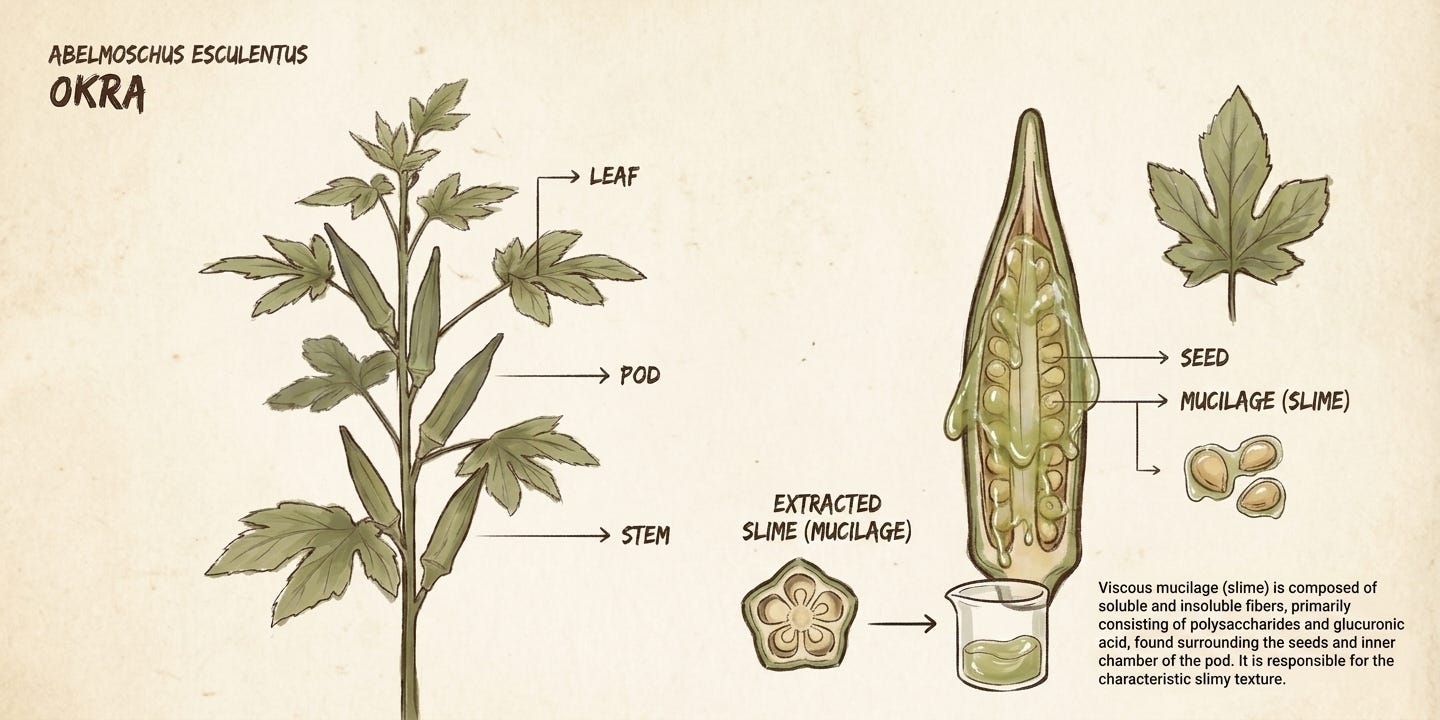
Okra mucilage is made up of something called polysaccharides, complex carbohydrate chains that are non-toxic, biodegradable, and capable of forming flexible films and gels. When these chains come into contact with contaminants in water, they bind to those particles and pull them out of suspension. The particles clump together, get heavy, and sink. The water above them clears.
Researchers have been studying this property for years as an alternative to the synthetic chemicals currently used in water treatment. Those conventional chemicals, primarily aluminum and iron-based compounds, work well but leave residues that raise long-term concerns. Okra mucilage, unlike those chemicals, leaves nothing behind. It’s biodegradable. It breaks down. And in controlled studies, it has reduced the cloudiness in water samples by more than 98 percent.
Then… the microplastics research came in.
A 2025 study published by the American Chemical Society tested okra and fenugreek extracts against real-world water samples. Surface water, ocean water, groundwater… all from multiple US regions, all contaminated with different shapes, sizes, and types of microplastics. Okra extracts removed the majority of microplastics across all sample types. The researchers noted that okra and fenugreek could serve as a much better alternatives to polyacrylamide, the synthetic chemical currently used in most wastewater treatment facilities worldwide.
...Microplastics are now found in human blood, lungs, breast milk, and placentas. The thing that could help pull them out of drinking water is sitting in a produce aisle, being avoided because of how it feels on a fork.
The wound healing research is its own separate story. (working on it now)
Okra mucilage has been studied as a drug delivery platform, a material that can carry medications to a specific site in the body and release them on a controlled schedule. Its pH-responsive behavior, the way it swells or contracts depending on the acidity of its environment, makes it useful for delivering drugs to precise locations in the digestive tract. Separate studies have tested okra-derived hydrogel dressings on diabetic wounds, which I recently found are notoriously difficult to heal.
And then theirs the films.
Because okra mucilage forms strong water-retaining films, researchers are investigating it as a component in biodegradable plastic packaging. Films that break down naturally. Films that could replace petroleum-based packaging for food and non-food products. Films made from the same substance people scrape off their cutting boards.
The plant has been cultivated for at least 3,500 years in northeast Africa and the Middle East. Its been eaten in every warm climate on Earth. It has also survived everything from Egyptian cuisine to Southern American cooking. The one consistent complaint, across every culture that grows it… is the slime.
And the slime is the whole point.
Which is pretty insane.
Sources
American Chemical Society. “Research Update: Okra, fenugreek extracts remove most microplastics from water.” https://www.acs.org/pressroom/presspacs/2025/may/research-update-okra-fenugreek-extracts-remove-most-microplastics-from-water.html
PMC / ACS Omega. “Fenugreek and Okra Polymers as Treatment Agents for the Removal of Microplastics from Water Sources.” https://pmc.ncbi.nlm.nih.gov/articles/PMC12019522/
ScienceDirect. “A comprehensive study to evaluate the wound healing potential of okra.” https://www.sciencedirect.com/science/article/abs/pii/S0378874121010734
ScienceDirect. “Grafting modification of okra mucilage: Recent findings, applications, and future directions.” https://www.sciencedirect.com/science/article/abs/pii/S0144861720308274
ScienceDirect. “Enhanced wound-healing by hydrogel from okra mucilage.” https://www.sciencedirect.com/science/article/abs/pii/S0014305725000369
ScienceDirect. “Plant-based mucilage with healing and anti-inflammatory actions for topical application.” https://www.sciencedirect.com/science/article/pii/S2667025921000054
Redalyc / Scielo Colombia. “Evaluation of mucilage and powder of Okra as bio-flocculant in water treatment.” https://www.redalyc.org/journal/3420/342063962003/html/
Dr. Clark Store. “How Does Okra Remove Microplastics?” https://drclarkstore.com/blogs/news/how-does-okra-remove-microplastics
IJCRT. “A Review On Okra Mucilage Packaging Film As A Biodegradable Material.” https://www.ijcrt.org/papers/IJCRT2504669.pdf
Springer Nature / Applied Water Science. “Microplastic removal using Okra seed from aqueous solutions.” https://link.springer.com/article/10.1007/s13201-024-02249-5