

The Nut That Grows In Poison
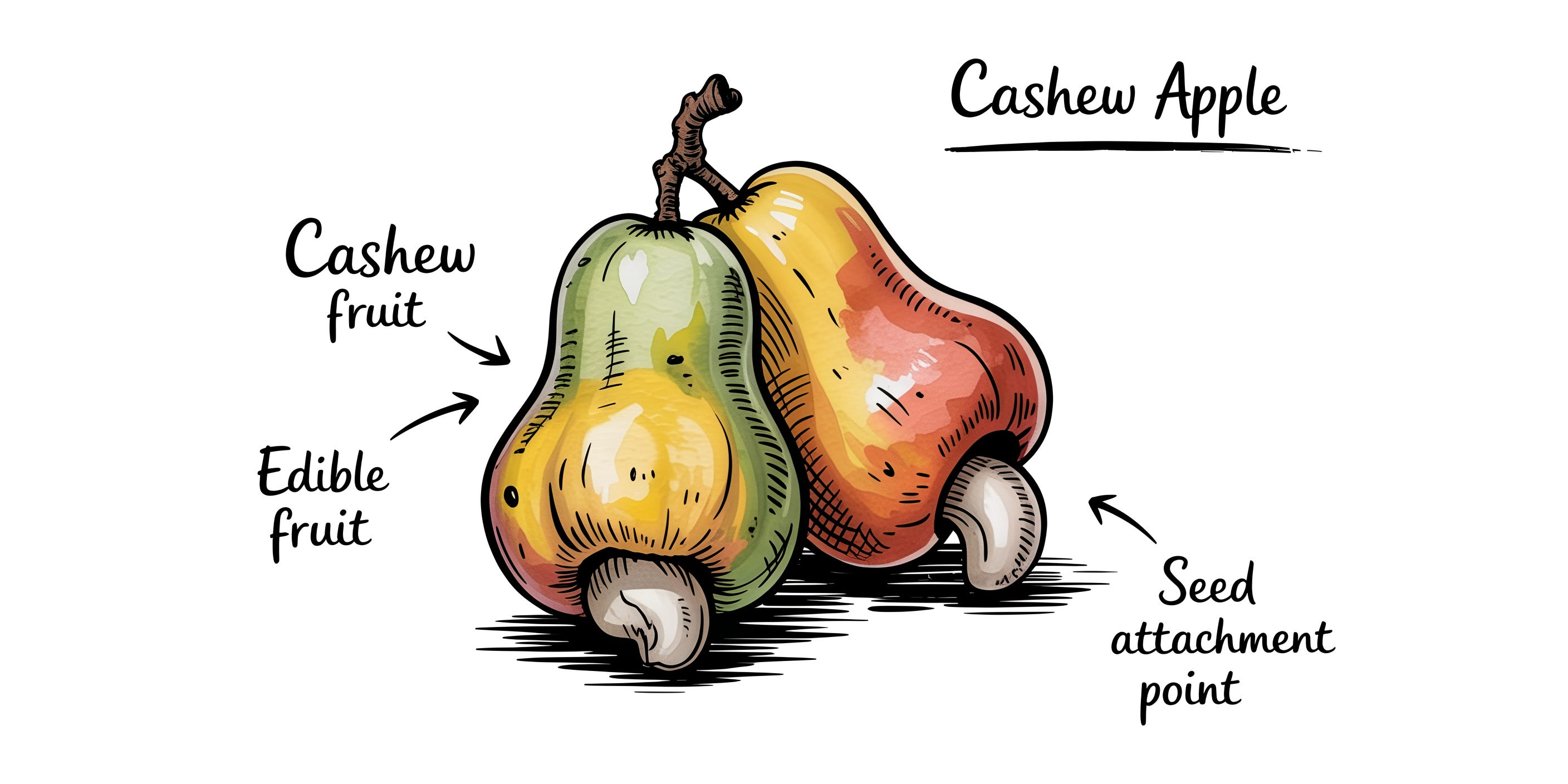
Most of you have never seen a cashew grown. That’s because they grow on apples.
Real cashews don’t grow in shells or pods like other nuts.¹ They grow on the bottom of fruit on a tree called the cashew apple.² It’s like a little hook hanging off the bottom.³ The cashew nut is actually the seed, a kidney-shaped drupe that grows at the end of the cashew apple.⁴ The drupe develops first on the tree, then the pedicel expands to become the cashew apple.⁵
The cashew apple is technically a false fruit or accessory fruit because it develops from parts of the flower other than the ovary.⁶ The apple itself is bright red or yellow, juicy, sweet, and astringent.⁷ It’s edible and nutritious, it has high levels of vitamin C.⁸ But it’s highly perishable, with a fragile peel that breaks easily, making it unsuitable for transport or international markets.⁹
And what’s even stranger is that the cashew nut is poisonous off the tree. The seed is surrounded by a double shell that contains anacardic acid, a potent skin irritant chemically related to urushiol, the toxic allergenic oil found in poison ivy.¹⁰ Cashew trees are part of the Anacardiaceae family, which includes mango, poison ivy, poison sumac, and pistachio.¹¹ They all contain urushiol.¹²
The cashew shell contains oil compounds that cause contact dermatitis similar to poison ivy.¹³ A brown oily resin is produced between the two shells and can blister human skin.¹⁴ Coming into contact with urushiol causes itching, blisters, and skin rashes.¹⁵ In 1982, more than 7,500 bags of cashews contaminated by shell pieces were sold in Pennsylvania and Maryland as part of a Little League fundraiser.¹⁶ About 20% of purchasers experienced pruritic dermatitis.¹⁷
The only way you can eat them is if they’re roasted. The cashew apples are picked by hand, and the curved nuts are first detached and then sun-dried.¹⁸ The nuts must be heated at high temperatures, either through roasting or steaming, to neutralize the toxic substances.¹⁹ Roasting at 210°C destroys the shell oil.²⁰ This removes the harmful compounds and ensures the nut inside is safe to eat.²¹
Even cashews labeled as “raw” in stores have been steamed or roasted to remove urushiol.²² They’re called raw because they haven’t had salt or flavorings added, but they’ve all been heat-treated.²³ Because cashews can cause dermatitis, they’re never sold in the shell to consumers.²⁴
In places like Brazil and India, the apple part is used to make juices or vinegar. In the Indian state of Goa, ripened cashew apples are mashed and the juice, called “neero,” is extracted and fermented for a few days.²⁵ This fermented juice undergoes double distillation to create a beverage called feni.²⁶ In Cambodia, where the plant is usually grown as an ornamental rather than an economic tree, the fruit is a delicacy eaten with salt.²⁷
But the seeds go through shelling, sorting, and sometimes even acid baths. Processing cashews is laborious and dangerous.²⁸ Workers in cashew processing plants, nearly all women, are employed without contracts, with no guarantee of steady income, no pension or holiday pay.²⁹ Many don’t even get gloves, and if they did, they probably couldn’t afford to wear them because gloves slow down their shelling speed, and they’re paid by the kilo.³⁰ Burns are a fact of life for up to 500,000 workers in India’s cashew industry.³¹
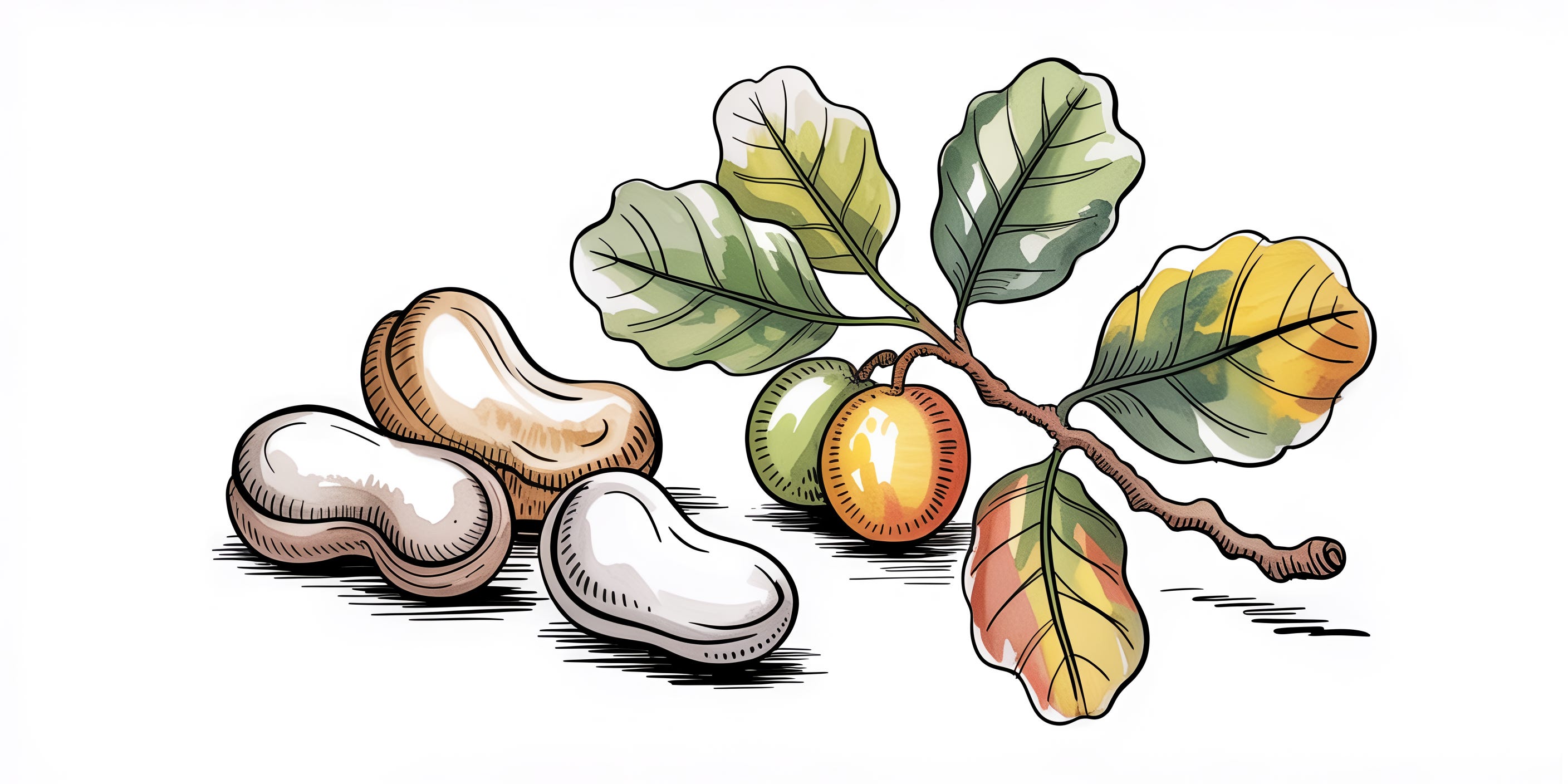
The cashew shell oil is actually valuable. The liquid, called CNSL (Cashew Nut Shell Liquid), contains anacardic acid (71.7%), cardol (18.7%), cardanol (4.7%), and other phenolic compounds.³² It’s used as a resin for carbon composite products, in the production of varnishes, lubricants, paints, cement waterproofing, and insecticides.³³ From 1 ton of dry cashew nuts, processors obtain approximately 250-300 kg of kernels and 700-750 kg of shells, which yield around 154 kg of oil.³⁴
How our ancestors discovered this, I have no idea. The cashew is native to tropical South America, from Central America and the Caribbean to northeastern Brazil.³⁵ The word cashew derives from the Tupian word “acajú,” meaning “nut that produces itself.”³⁶ Portuguese colonists in Brazil began exporting cashew nuts as early as the 1550s.³⁷ The Portuguese took it to Goa, India, between 1560 and 1565.³⁸ From there, it spread throughout Southeast Asia and eventually Africa.³⁹
But now it’s one of the most popular nuts in the world. In 2023, 3.9 million tons of cashew nuts were harvested globally, led by the Ivory Coast and India.⁴⁰ Vietnam, India, and the Ivory Coast account for 58.3% of world production.⁴¹
Which means one of the most popular snacks in the world comes from a fruit that’s too delicate to ship, grows a seed coated in the same oil that causes poison ivy rashes, requires dangerous manual labor to process, and had to be discovered by people who somehow figured out that heating these toxic shells makes the nut inside safe to eat.
The cashew didn’t choose to be poison. That’s just what it takes to get from tree to table.