

The Pepper That Could Have Saved Two Million Sailors
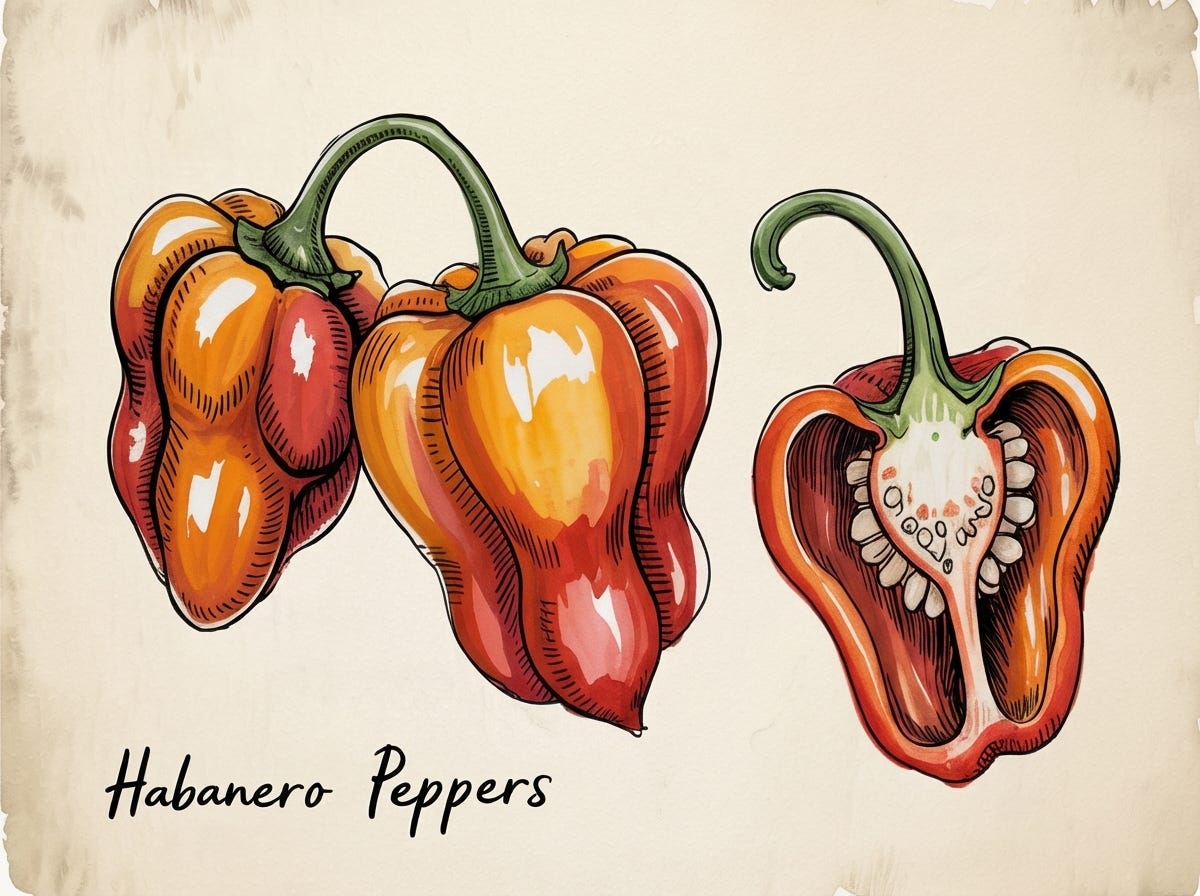
One of the deadliest peppers that could keep you alive is the habanero.
Habaneros are one of the spiciest fruits on this planet. They register between 100,000 and 350,000 Scoville Heat Units. For comparison, a jalapeño tops out around 8,000. The burn is immediate and it lingers.
They trick your nerves into thinking your mouth is on fire. Capsaicin binds to TRPV1 receptors, the same ones that detect actual heat. Your brain gets the signal. Pain. Fire. Danger. Your mouth sweats, your nose runs, your heart races. This certainly does not feel like a trick.
But capsaicin — the compound doing that — contains more vitamin C than an orange. A single habanero pepper provides about 107 milligrams of vitamin C. An orange gives you about 70. The pepper has roughly 50 percent more.
Vitamin C is the only thing stopping your gums from rotting and your teeth from falling out. Humans lost the ability to synthesize their own vitamin C millions of years ago. We’re one of the few mammals that has to get it from food. Without it, collagen production fails. Blood vessels weaken. Wounds stop healing. Gums bleed and recede. Teeth loosen and fall out. Eventually, you die.
Between 1500 and 1800, scurvy killed two million sailors. More than enemy combat. More than shipwrecks. More than all the other diseases combined. On long voyages, men ate hardtack and salt beef. No fresh fruit. No vegetables. After a few months, their gums swelled. Their teeth loosened. Their legs ached. Their scars reopened. By the time they reached port, many couldn’t stand.
While habaneros were sitting in the Americas the entire time. They’d been cultivated in Mexico and the Caribbean for thousands of years. The Maya and Aztec used them for food, medicine, and ritual. But European sailors never connected the dots. They didn’t know why men got sick. They just knew they did.
It wasn’t until 1932 that scientists even identified what vitamin C was. Albert Szent-Györgyi isolated it from paprika, of all things. He won a Nobel Prize for it. By then, the age of sail was over. The ships were steel. The sailors were fed better. But two million men had already died.
Two million people lost their teeth and their lives to a disease this pepper could have stopped. A fruit that burns your mouth could have saved theirs. It was there the whole time. They just didn’t know.
Sources
USDA FoodData Central. (2024). “Peppers, habanero, raw.” https://fdc.nal.usda.gov/fdc-app.html#/food-details/2346395/nutrients
Oregon State University Linus Pauling Institute. (2024). “Vitamin C.” https://lpi.oregonstate.edu/mic/vitamins/vitamin-C
National Institutes of Health Office of Dietary Supplements. (2024). “Vitamin C Fact Sheet.” https://ods.od.nih.gov/factsheets/VitaminC-HealthProfessional/
Lamb, J. (2017). “Scurvy: The Scourge of the Sea.” Royal Museums Greenwich. https://www.rmg.co.uk/stories/topics/scurvy
National Library of Medicine. (2022). “Scurvy: Historical Review and Current Diagnostic Approach.” American Journal of Medicine. https://pubmed.ncbi.nlm.nih.gov/34902350/
Carpenter, K.J. (2012). “The History of Scurvy and Vitamin C.” Cambridge University Press. https://www.cambridge.org/core/books/history-of-scurvy-and-vitamin-c/B6C4F9B2E4A7F8D9F3E2A1B5C8D7E9F0