

The US Government Legally Defined Something That Doesn't Exist
Vegetables don’t actually exist.
Not scientifically… Not botanically... Not in any classification system that plant biology actually uses. Wolfgang Stuppy, a research leader in comparative plant and fungal biology at the Royal Botanic Gardens, Kew, one of the most respected botanical institutions on Earth, told the BBC plainly, “The term vegetable doesn’t exist in botanical terminology.”
Fruit exists... Roots exist… Seeds exist... Leaves, stems, bulbs, and flowers all exist as defined botanical structures with real scientific meanings. But “vegetables” doesn’t. Its a culinary term, defined by things like taste and usage and human habit, with no scientific value whatsoever.
Which means the argument was always a fight over a category that doesn’t exist.
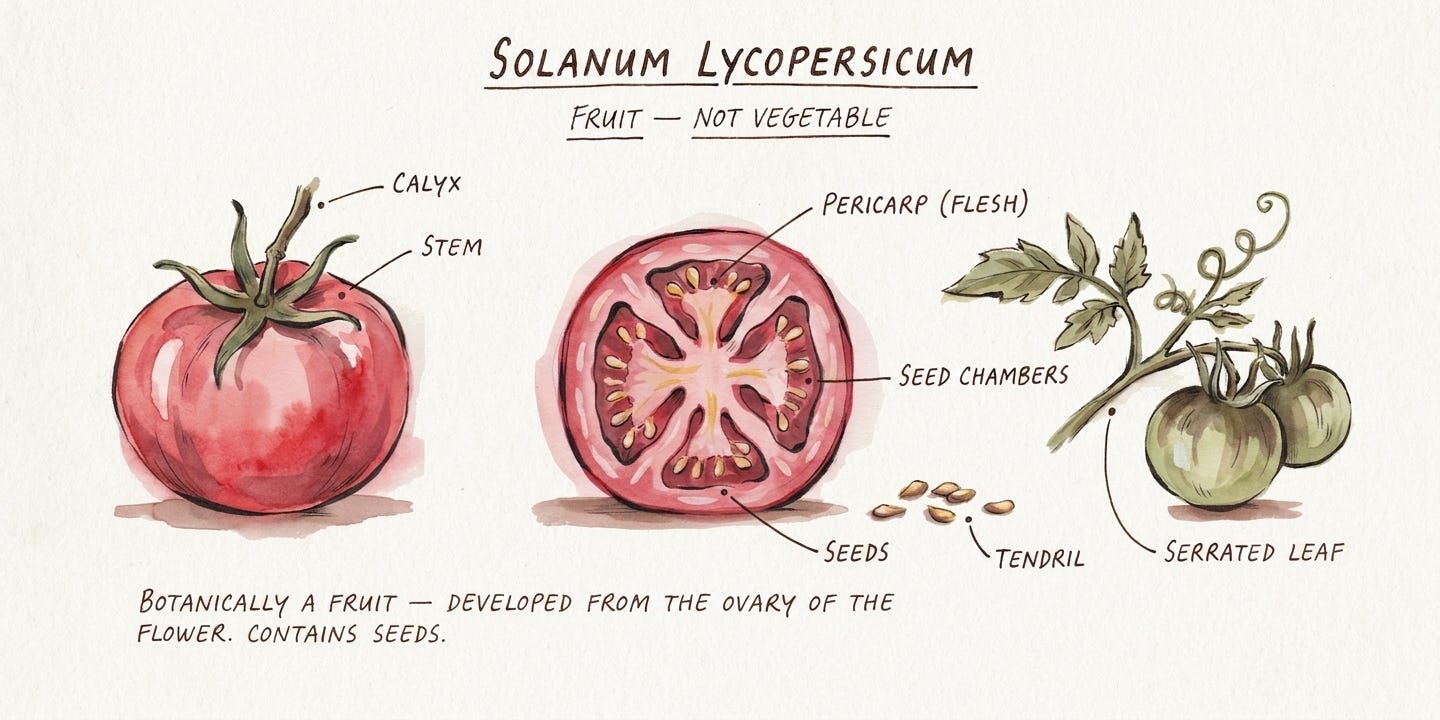
In 1883, Congress passed a tariff act that would eventually reach the Supreme Court. The act taxed imported vegetables but not imported fruits. A fruit importer named John Nix had been bringing tomatoes into New York from the Caribbean, and the port collector, a man named Edward Hedden, taxed them as vegetables. Nix argued they were fruits. He was right… botanically. A tomato develops from the ovary of the tomato plant’s flower. It contains seeds. By every scientific definition, it is a fruit. Nix sued to get his tariff money back.
The case went to the Supreme Court of the United States.
Both sides brought in witnesses. Both sides read definitions from dictionaries. The only witnesses called at trial testified that neither “vegetables” nor “fruit” had any special meaning in trade or commerce different from what the dictionaries said. Nix’s lawyers cited botanical definitions of fruit. Hedden’s lawyers cited the words pea, cucumber, squash, eggplant, and pepper, all botanical fruits that everyone in a kitchen calls vegetables.
On May 10, 1893, the Supreme Court ruled unanimously that the tomato is a vegetable.
The Court’s reasoning was not botanical. It was social. The majority opinion held that the Tariff Act used the ordinary meaning of the words “fruit” and “vegetable” rather than any technical botanical meaning, because that is how the words are used by people who actually grow, sell, and eat food. The tomato is “in common parlance” a vegetable because it is served at dinner, not dessert. It is eaten with the meal, not after it. That was the entire argument.
Nine justices agreed.
The highest court in the country defined a food category not by what it was but by when you eat it.
The tomato didn’t change… Its biology didn’t change... It still develops from a flower and it still has seeds. It is still, by every scientific standard available in 1893 or even today, a fruit. The Supreme Court simply decided that science was not the relevant authority on the question, and the law has used that logic ever since.
The category the court was asked to rule on, vegetable, has no scientific definition. The court acknowledged this and ruled it anyway, based on common usage. Which means the United States federal government has a legally binding definition of something that does not biologically exist.
Cucumbers, peppers, squash, eggplant, avocado, and pumpkin are all botanically fruits that someone decided to eat with dinner instead of after it. Every item you’ve ever called a vegetable is either a root, a stem, a leaf, a flower, a bulb, a seed, or a botanical fruit the law decided to rename.
There is no vegetable… There never was… There is only a meal, and the things you put in it, and a Supreme Court decision.
Which is… pretty insane.
Sources
Wikipedia. “Nix v. Hedden.” https://en.wikipedia.org/wiki/Nix_v._Hedden
Legal Information Institute / Cornell Law. “NIX v. HEDDEN, Collector.” https://www.law.cornell.edu/supremecourt/text/149/304
Justia US Supreme Court. “Nix v. Hedden, 149 U.S. 304 (1893).” https://supreme.justia.com/cases/federal/us/149/304/
FindLaw. “NIX v. HEDDEN, 149 U.S. 304 (1893).” https://caselaw.findlaw.com/court/us-supreme-court/149/304.html
ISCOTUS / Chicago-Kent Law. “The Supreme Court and the Great Tomato Controversy.” https://blogs.kentlaw.iit.edu/iscotus/supreme-court-great-tomato-debate/
HuffPost. “Botanists Say There’s No Such Thing As Vegetables.” https://www.huffpost.com/entry/botanists-no-such-thing-vegetables_n_593fdbcee4b0b13f2c6dcd9c
CNN. “There’s actually no such thing as vegetables.” https://www.cnn.com/2024/05/05/health/what-are-vegetables-nutrients-plants-wellness
ScienceDaily. “Vegetable.” https://www.sciencedaily.com/terms/vegetable.htm
New World Encyclopedia. “Vegetable.” https://www.newworldencyclopedia.org/entry/Vegetable
IOSR Journals. “The Myth of Vegetables: Why They Don’t Exist in a Botanical Sense.” https://www.iosrjournals.org/manuscript_paper/863418.pdf
Pinetree Garden Seeds. “Vegetables aren’t real.” https://www.superseeds.com/blogs/know-your-roots/vegetables-arent-real